
Advice
Practical guidance for homeowners planning construction work, choosing builders and resolving problems during a build. Start with the issue you face, then follow the related checks and next steps.
Before you ask for prices
Can a builder price from planning drawings? · What information does a builder need to quote? · Set a realistic extension budget · Write a building specification · Planning versus building regulations
Quotes and choosing a builder
Compare builders’ quotes · Check what a quote includes · Check a builder before hiring · Understand allowances · Check builder insurance
Contracts, deposits and payments
Building contract checklist · How much deposit? · Payment schedule · No written contract? · Builder asks for money early
When the job changes or stalls
Project over budget · Builder taking too long · Project gone wrong · Builder gone bust · Work differs from drawings
For independent advice on your own project, see Build Advocate’s comprehensive £999 package
Fixed price or estimate from a builder: what is the difference?
A fixed price only fixes the work it actually describes. Understand the scope, assumptions and change rules before comparing prices.
“Fixed price” sounds reassuring, while “estimate” sounds uncertain. Neither label tells you enough on its own. The price is only as clear as the work, drawings, allowances and contract behind it. Before comparing builders, ask what each figure includes and what could change it.
What a fixed price can mean
A builder may offer a lump sum for a defined scope. If the agreed work is carried out as specified, that sum is the starting contractual price. It does not freeze the cost of later homeowner changes, hidden conditions, omitted design details or items expressly excluded. Some contracts also have particular mechanisms for price adjustments. Read the actual terms, not just the heading on the quote.
A £120,000 fixed price for an extension with “kitchen by owner, electrics provisional, drainage subject to survey” does not give a complete £120,000 project budget. Those examples illustrate categories of uncertainty, not an assessment of any particular quote.
What an estimate can mean
An estimate is a forecast of likely cost based on the information available. Its reliability depends on the completeness of drawings, survey, specification and quantities. An early estimate may be useful for deciding whether to continue with design. It is a weak basis for committing to a contractor if major items remain undefined.
Ask whether it is a total for an assumed scope, a range, a cost plan with allowances, or a builder’s working budget. Ask what evidence would turn it into a price for the actual work.
Read the moving parts
List the exclusions, provisional sums, prime cost allowances, client-supplied materials, VAT treatment and any items marked “to be confirmed.” Ask whether design, structural steel, scaffold, waste, building control, decoration and finishes are included where relevant. The items vary by job; use the quote completeness guide to work systematically.
Then look at the programme and payment schedule. A short price can hide a long job; a lower total can depend on the homeowner ordering or coordinating major parts of the work. Compare the same scope and responsibility between bidders, as explained in our quote comparison guide.
Ask how changes will be priced
Before signing, agree the written procedure for variations: who may instruct a change, how the price is agreed, what records support it and how the completion date changes. A good fixed price becomes much less useful if this process is vague. Read our guide to agreeing builder variations.
Decide at the right stage
If the design is early, use an appropriately qualified cost assessment to test affordability and identify missing information. If you are ready to appoint, insist that the builders price a common, sufficiently detailed package and state every qualification. Build Advocate’s Cost & Readiness Assessment can assess an early project; the builder selection service can review proposed appointments. Neither turns incomplete design information into a guaranteed construction price.
Builder variations: how to agree extras before the bill arrives
Changes and unforeseen work can be legitimate. Here is how to define the extra, price it and record its effect on the programme.
A variation is a change to the work agreed in the contract. It may be a homeowner choice, a design change or necessary work discovered after opening up the building. The key question is what changed from the original scope, why, and what does that do to price and time? A verbal “we’ll sort it later” leaves both sides exposed.
Start with the original documents
Find the signed quotation or contract, drawings, specification, exclusions and any agreed allowances. Compare the proposed extra against them. If a builder asks for more to install a feature already specified and priced, ask why. If the drawings never identified it, or the existing structure has concealed damage, the position may be different. Do not assume that every surprise is automatically an extra or automatically included.
Provisional sums and allowances deserve special attention. An allowance may cover only a defined amount or part of the work. Check whether the new charge replaces the allowance, supplements it, or duplicates something already included. Our guide to reading a builder’s quote explains the underlying scope issue.
Get a written change before proceeding
For each proposed variation, record the location, description, reason, reference drawing or photograph, labour and materials basis where appropriate, net increase or decrease, tax treatment, effect on other work and revised completion date. Ask what happens if you decline it. Give the builder a clear written approval or rejection according to the contract’s procedure.
Some urgent discoveries must be made safe immediately. Record photographs and the condition before work is covered, and separate emergency protection from the permanent solution. A structural, electrical or other specialist judgement may be needed before selecting the remedy.
Test the consequence, not just the line price
A £1,000 change can delay a kitchen installation, cause a second scaffold visit or hold up inspections. Conversely, removing work should produce a clear credit. Update the programme and payment schedule, and show the cumulative effect of all approved changes. A stack of individually modest extras can exhaust a contingency.
Keep a change register: reference, date raised, status, cost, time effect, approval and invoice. Reconcile it at each payment. If the builder is already asking for more money than quoted, that separate guide helps you assemble the facts before responding.
When the price is disputed
Do not silently instruct work while arguing about its price. Ask for the contractual basis, the supporting records and the alternative options. Preserve correspondence and site records. If the issue concerns defective work, a design error or a formal dispute, obtain the right independent specialist or legal advice for that issue. Build Advocate can help you understand the scope, cost and practical next step without taking over your project.
Builder payment schedule: link payments to work and procurement
A practical way to agree stage payments, pre-start purchases and final balance without leaving the homeowner or builder funding the whole job.
A sensible payment schedule answers two questions at once: what does the builder need to fund the next stage, and what has the homeowner received for the money paid? A flat percentage every Friday rarely answers either. Agree the stages, amounts and evidence before work starts, then use the contract to record how changes are approved.
Map the money to the actual programme
Start with a written scope and a realistic sequence: access and scaffold, structural work, weatherproofing, first fix, finishes and handover. Show when major materials must be ordered, when they arrive, and when subcontractors are due. A builder may reasonably need funds for steel or scaffold before much visible work appears, but the item, amount, order, delivery and ownership arrangements should be transparent.
Do not treat a protected booking deposit as if it automatically pays for mobilisation. If a separate pre-start payment is needed, describe precisely what it covers and when it becomes due. The contract should say what happens if a start date changes or an ordered item cannot be supplied.
Agree measurable payment triggers
For each stage, write down the work or procurement event, the amount due, the evidence to be provided and the payment date. “First fix complete” needs a definition: which rooms and services, whether inspections are needed, and which work remains. A stage is easier to verify when it corresponds to a completed area or a specific delivered item.
Check that cumulative payments do not race far ahead of completed work and identifiable materials. Equally, do not expect the builder to carry weeks of labour, scaffold and ordered materials without cash flow. The right schedule depends on the job, its supply chain and the contract; there is no universal safe percentage.
Keep variations separate
When the homeowner changes a bathroom layout or hidden work is found, record the description, price basis, time effect and approval before the extra work proceeds where practical. Update the remaining balance and future stages. Otherwise an apparently tidy original schedule quickly becomes meaningless. See our guide to a builder asking for more money.
Protect the final stages
Define completion, testing, certificates, outstanding defects and handover documents. Agree how the final balance is assessed under the chosen contract. Do not improvise a withholding figure after a dispute starts. JCT Home Owner contracts are one established route for domestic work; use the form appropriate to the appointment and understand its payment and administration provisions before signing.
If the schedule is already slipping, compare paid amounts with completed scope, ordered materials and the current programme. Keep invoices, delivery notes, photographs and written changes together.
Before you agree
Ask for the scope, programme, stage descriptions, payment amounts, procurement assumptions, change procedure and contract in one connected set. An independent comparison can reveal where cash flow is unrealistic or where the homeowner would pay ahead of value. Build Advocate can review your proposed builder appointment and payment arrangements before you commit.
What is a schedule of works for a home building project?
A schedule of works defines what the builder is pricing and delivering. Learn how it differs from drawings, a programme and a bill of quantities.
A schedule of works is a structured description of the work to be carried out. It helps the homeowner, designer and builders agree what is included before prices are compared or a contract is signed. It should be read alongside the current drawings and specification, not as a replacement for them.
What goes into a useful schedule?
Start with the site and project information, the drawing register and the boundaries of the proposed work. Then organise the operations in a sequence or trade structure that a builder can price: site setup and protection; demolition and alteration; groundworks and structure; roof and external envelope; windows and doors; plumbing, heating and electrics; partitions and finishes; external works; testing, making good and handover.
For each activity, describe the location, outcome, relevant drawing or detail and who supplies and installs the item. Record homeowner choices that remain open as clear allowances or decisions, rather than hiding them in “to be agreed”. Include access, working around an occupied home, temporary weather protection and removal of waste where relevant.
How is it different from the other documents?
Drawings show geometry, location and design detail.
A specification states product, performance and workmanship requirements.
A schedule of works brings the operations and scope together so they can be priced and delivered.
A bill of quantities measures and describes items in a formal pricing structure.
A programme shows when activities are planned and how they depend on each other.
The documents overlap, but they answer different questions. A programme bar labelled “first fix” does not say how many electrical points or plumbing connections are included. A floor plan may show a bathroom without settling who supplies the sanitaryware or tiles.
A small example of a costly gap
Suppose a loft drawing shows a new staircase. A schedule should also address the opening and trimming, temporary support, stair manufacture and installation, guarding, fire-door or alarm alterations where required by the design, making good and protection of the occupied route. Without those words, builders may price different scopes even though they saw the same plan.
Do not use an example schedule as a design instruction. The structural and fire-safety requirements must come from the appropriate project information and specialists.
Use it to tender and control changes
Issue the same dated schedule and drawing revisions to each builder. Ask each to identify exclusions, substitutions and allowances in writing. When a design changes, revise the schedule or record an agreed variation so the contract documents remain coherent. Our quote comparison guide shows why a common scope matters.
A schedule is only as reliable as the information behind it. If structural, drainage or specification decisions are missing, mark them as unresolved and budget for the uncertainty. Our planning-drawings guide explains why early plans often support only an indicative estimate.
How Build Advocate can help
The Cost & Readiness Assessment reviews the available design and scope, identifies missing decisions and gives an evidenced estimate appropriate to the information. It can show what needs defining before a more detailed tender. It does not produce a full construction design or replace your architect and engineer.
Building project gone wrong? What to do first
When a building project starts going wrong, prioritise safety and weather protection, preserve records, separate urgent work from disputed costs and get a clear next-step assessment.
When a building project goes wrong, the first priority is to keep people and the property safe and prevent avoidable damage. Then establish what has actually been built, paid for and agreed. A rushed argument about blame can make it harder to resolve the practical problem in front of you.
Deal with immediate risk
If there is a dangerous condition, unsafe access, exposed electrics or an opening that could let water into the house, keep people away and contact the appropriate qualified person or emergency service. Record the condition before urgent protective work where safe to do so. Tell the builder promptly in writing what you found and what temporary action is needed.
Temporary weather protection and securing the site are different from authorising permanent remedial work or accepting responsibility for a defect. Be clear about which action is urgent and what remains to be assessed.
Make one reliable project record
Gather the signed agreement, quotations, drawings and revisions, specification, programme, invoices, payment receipts, inspection records, photographs and messages. Put them in date order. Note who instructed each change and whether its price and time effect were agreed before the work.
List the current position under four headings: work complete, work incomplete, work you believe may be defective, and work whose scope or payment is disputed. Do not describe an uninspected item as defective fact. Mark it for specialist checking where necessary.
Reconcile the money
Record the original price, agreed variations, payments made, materials paid for but not installed, disputed requests and the balance claimed by each side. Compare that with the value of work visibly complete and the likely cost of completing what remains. These are different figures, and early uncertainty should stay visible.
Do not assume that paying an extra invoice will solve the delivery issue, or that withholding everything will be consequence-free. Contractual rights and notices need advice on the actual agreement. Our guide to extra payment requests helps organise the builder’s explanation.
Ask for a specific written response
Send a short list of the issues rather than a long stream of messages. For each one, ask what the builder proposes, who will do it, when, how it affects the programme and whether there is an extra charge. Keep agreed and disputed matters separate. If the builder has stopped attending, ask for an explicit return plan and how the site will be left meanwhile.
Bring in the right expertise
A structural concern may need an engineer; water ingress or defective work may need an independent inspection; a contract dispute may need a solicitor or consumer adviser. Build Advocate can help frame the issue and identify which specialist judgement is required, but does not replace it. Citizens Advice provides consumer guidance on problems with home improvements.
Define the next decision
The immediate question might be “How do we keep the property safe tonight?”, “What work is left and what will it cost?” or “Can this builder complete it under a credible plan?” Answer those in order before deciding whether to renegotiate, appoint somebody else or escalate a dispute. Our delay guide covers a slipping programme in more detail.
Build Advocate’s Rescue Initial Assessment reviews the available evidence and defines the practical next action, with a one-hour review call. Site visits, independent specialists and further intervention are separately scoped.
Builder taking too long? How to assess a delayed building project
Work is slipping and the finish date keeps moving. Compare the agreed programme with actual progress, identify the blockage and ask for a credible recovery plan.
If your building project is taking longer than expected, establish the facts before arguing about a finish date. A delayed delivery, design decision or concealed condition can affect the programme; repeated absences and an unrealistic original duration can do the same. The next step depends on which activities are actually holding up completion.
Start with the agreed baseline
Collect the contract, quotation, start-date correspondence, any construction programme and records of agreed changes. Was the finish date fixed, estimated or conditional on information you had to provide? Note the dates of revisions and any extension-of-time notices, but do not assume a general online article decides contractual entitlement.
Write down the work that should have been complete by now and the work actually complete. Distinguish visible progress from hidden milestones such as ordered windows, inspections, first-fix services and drying time. Photographs dated each week are more useful than relying on memory.
Find the activities that control the finish
Ask the builder for a current sequence covering the remaining structural work, weatherproofing, services, finishes, inspections and handover. Which trades are needed, when are they booked and which decisions or materials are blocking them? A promise to “put more men on it” is not a recovery programme if they cannot work safely or productively in the same space.
Check who is responsible for each delay: the builder’s resources, a subcontractor, late design information, a homeowner selection, weather, unforeseen conditions or an instructed change. More than one cause may overlap. Record what evidence supports the explanation and what remains uncertain.
Ask for a written recovery plan
A useful request is specific: “Please send the updated programme showing completed work, remaining tasks, labour and subcontractor dates, outstanding materials, decisions required from us and your current forecast completion date. Please identify the reasons for movement from the previous programme.”
Agree immediate decisions and access arrangements promptly where they are genuinely yours. Keep a record of replies and site attendance. If the builder gives a new date, ask what has changed in the resources or sequence to make that date achievable.
Keep money and progress connected
Compare payments already made with completed work, ordered materials and the unpaid balance. If the builder asks for an early payment to accelerate work, ask exactly what it funds and how it changes the programme. Do not automatically pay ahead or stop all payments without understanding the contract and possible consequences. Our guide to extra payment requests helps separate a price increase from a timing change.
When the situation is deteriorating
If the builder has stopped attending, the site is unsafe, the property is exposed or communication has broken down, record the condition and seek the right specialist support promptly. Protecting an opening from weather and preserving evidence may be more urgent than settling blame. Questions about notices, withholding payment, termination or a legal claim need advice based on the actual contract and location. Citizens Advice provides consumer guidance for problems with home improvements.
Independent next-step assessment
Build Advocate’s Rescue Initial Assessment reviews the available information, identifies immediate priorities and gives you a practical route forward. Further site work or specialist input is separately scoped. We help establish what is happening; we do not take over the builder’s programme by default.
How much deposit should you pay a builder?
There is no single safe percentage for every job. Understand booking, mobilisation, materials and stage payments before transferring money.
There is no single deposit percentage that works for every building project. A sensible amount depends on what it secures, when work starts, what needs to be ordered and how the rest of the job will be funded. Money paid six months before work begins serves a different purpose from a pre-start payment for steel, scaffold and early labour.
Ask what the money is for
A booking deposit may reserve a start period. Ask where it is held, when it is released and what happens if either side changes the date or cancels. A mobilisation payment may fund identifiable setup and procurement shortly before work starts. Stage payments should correspond to agreed work or commitments during the build. Do not let one word—“deposit”—hide all three.
If a contractor asks for a large amount far in advance, request a breakdown: which named materials or commitments are needed now, when they will be paid for, who owns them, where they will be stored and what evidence you will receive. If a protection arrangement holds the money, understand its release terms. A protected booking amount held until completion cannot itself fund early mobilisation.
Before paying, check the essentials
Is the builder’s identity the same on the quotation, contract, invoice and bank details?
Have you agreed the scope, drawings, price basis, start window and payment schedule in writing?
What specifically will this payment purchase or secure, and when does it become due?
Are any materials bespoke, non-returnable or already ordered? What proof can be provided?
What happens if the design changes, the start is delayed or the appointment is cancelled?
How much remains unpaid at each stage relative to the work still to be delivered?
Do not judge the request only by a percentage. Ten per cent on a small labour-heavy job may be insufficient for planned procurement; the same percentage on a much larger job may exceed the immediate need. A plausible explanation still needs written terms and evidence.
Build a payment schedule that works for both parties
Builders should not have to finance large pre-start purchases and weeks of labour from their own cash. Homeowners should not be left having paid far ahead of work and materials without safeguards. A workable schedule separates early procurement, site mobilisation, subsequent milestones and the final balance. It states when invoices are issued and how quickly they are payable.
JCT’s Home Owner contract information identifies the price and payment schedule among the matters a domestic contract can record. Citizens Advice offers guidance before building work. Check the rules and contract relevant to your location and circumstances; this article is practical construction guidance, not legal advice.
If the request feels wrong
Pause and ask the builder to explain the purpose, calculation and release conditions in writing. Compare the request with the quoted work and proposed programme. If the builder needs money for materials, discuss a documented procurement arrangement rather than assuming either party should carry unlimited risk.
Our quote checklist and builder checks help with the wider appointment decision. Build Advocate’s Complete Builder Selection reviews the payment structure alongside the builder, scope, contract and programme before you commit.
How to check a builder before hiring them
Check the person, business, relevant work, references, insurance and written proposal before appointing a builder. A practical homeowner due-diligence checklist.
Before appointing a builder, check both the business and the proposal for your particular job. A recommendation or impressive portfolio is a useful starting point, but it does not establish who will do the work, what is included or whether the proposed programme is credible.
Confirm who you are contracting with
Ask for the legal business name, trading name, correspondence address and the person responsible for the job. If it is a limited company, check the company number and filing information on Companies House. The register confirms identity and filings; it is not a guarantee of workmanship or financial health. A sole trader will not have a company number.
Make sure the name on the quote, proposed contract, invoice and payment details is consistent. If it changes, ask why before paying.
Test relevant experience, not just photographs
Ask for recent projects similar in scope and complexity to yours. A builder experienced in simple extensions may still need a credible plan for an occupied loft conversion with structural alterations, multiple trades and weather protection. Ask what the builder personally managed, which subcontractors were used and what problems arose.
Speak to more than one previous client where possible. Ask about communication, changes, defects, payment requests and whether the final cost and finish date matched the original proposal. A completed-project visit is more useful when the owner can explain how the work actually went.
Check the proposed team and capacity
Who will supervise day to day? Which trades will be employed or subcontracted? How many jobs will the builder run at once? Ask for a programme showing the main stages, lead times and dependencies. A short finish date is credible only if the resources and sequence support it.
Ask how the site will be protected, how access and waste will be managed, and what happens if a key trade is unavailable. These questions reveal whether the quote was built around your house or a generic price.
Review insurance and credentials in context
Ask for current insurance evidence appropriate to the work and check the insured name, activity, period and limits. Where a scheme membership, trade qualification or guarantee is claimed, verify it through the issuer and understand what it covers. A badge alone is no substitute for clear scope and reliable references.
Specialist design, electrical work, gas work or other regulated tasks need the right competent person and documentation. Establish who arranges those people and who supplies the evidence at handover.
Put the appointment on paper
Compare the quote with the drawings and specification. Identify exclusions, allowances, client purchases, contract, payment stages, variation process and defect arrangements. Our quote checklist tests completeness; the comparison guide helps when several builders have priced different scopes.
Do not pay a booking or mobilisation amount until you understand what it secures, when it can be used and what happens if the start date or scope changes. A builder can reasonably need funded procurement and mobilisation, but the arrangement should be explicit and documented.
Need an independent comparison?
Build Advocate’s Complete Builder Selection compares up to three builders, examines missing scope and due diligence, and reviews proposed contract, payment and programme information. We have no financial stake in which builder you appoint.
What should be included in a builder’s quote?
A builder’s quote should define the drawings, scope, exclusions, allowances, programme and payment terms. Use this practical checklist before signing.
A useful builder’s quote tells you what will be built, what information it is based on, what it will cost and what remains uncertain. A detailed-looking list can still omit a major part of the job. Before comparing totals, check that the quotation describes a complete, buildable scope for your home.
Identify the documents being priced
The quote should identify the drawing and specification revisions, date of issue and any site visit or survey. If one builder priced a later design than another, their totals are not directly comparable. Ask which structural information, drainage details and selections were available. An early estimate based on planning drawings should say so clearly.
Look for these scope headings
Site setup: access, scaffold, welfare, protection, temporary support, skips and disposal.
Structure and envelope: foundations, steelwork, masonry or timber, roof, insulation, windows, doors and weatherproofing.
Services: plumbing, heating, electrics, ventilation, testing and connection to existing systems.
Internal work: partitions, plastering, joinery, stairs, finishes, making good and decoration.
External and existing-house work: drainage, ground reinstatement, repairs at junctions and alterations beyond the new room.
Handover: completion work, certification, defects process and final cleaning where agreed.
The exact headings vary with the project. The point is to make omissions visible. A line saying “all works as drawings” is only as clear as the drawings and the referenced specification.
Separate inclusions, exclusions and allowances
Ask who supplies and installs kitchens, sanitaryware, tiles, flooring and specialist items. “Client supply” can still leave installation, delivery, storage and damage responsibilities unclear. An exclusion should say what is excluded and who will arrange it.
For every provisional sum or allowance, record the assumed quantity, quality and whether fitting is included. Ask how the difference between the allowance and actual cost will be calculated, including any agreed overhead or profit and applicable VAT. Do not treat an allowance as a fixed price.
Check time, payment and change control
A quote should lead into a realistic programme and payment schedule. Ask when the builder can start, how long the works are expected to take, what work depends on design decisions or lead times, and who will manage subcontractors. Early payment for steel, scaffold or materials may be legitimate, but the purpose and evidence should be explicit.
Ask how variations will be instructed and priced before extra work starts. Record who can approve a change and whether it affects time as well as cost. A written contract helps connect scope, price, programme and payment. JCT’s Home Owner contract information shows the matters a domestic contract can record; use an appropriate agreement for the actual job.
Put the quote into the full project budget
Professional fees, approvals, client purchases and contingency may be outside the builder’s price. Our extension budgeting guide helps you assemble the whole cost. When comparing several builders, use the side-by-side quote method to identify differences in scope and allowances.
Before you sign
Ask for one revised, dated quotation that incorporates agreed clarifications. Keep the drawings and specification it refers to. If a large item remains unpriced, either resolve it or show the risk honestly in your budget. Build Advocate’s Cost & Readiness Assessment can review scope, budget and delivery risks before you commit; Complete Builder Selection compares up to three builders and their proposals.
How to set a realistic budget for a house extension
Set an extension budget that includes the whole project, not just the builder’s headline price. Check scope, fees, client purchases and uncertainty before commissioning detailed design.
A realistic extension budget starts with a defined scope and an honest list of unknowns. A price per square metre can help test whether an idea is broadly affordable, but it is not a quotation for your particular home. Before committing to detailed design or choosing a builder, separate the building work from professional fees, statutory costs, homeowner purchases and contingency.
Start with what the project must achieve
Write down the rooms, floor area and essential outcomes. Is the new space a simple shell, or does it include a kitchen, bathroom, structural opening, extensive glazing and alterations to existing rooms? Two extensions of the same size can have very different costs because the scope inside and at the junction with the house differs.
Set a target budget and an upper limit you would be comfortable funding. Include any financing costs and the amount you need to keep aside for other priorities. This is a decision threshold, not a target for a builder to spend.
Make a whole-project cost list
Construction: groundworks, structure, roof, envelope, openings, services, finishes, access, scaffold, skips and protection.
Design and approvals: architect or designer, structural engineer, surveys, planning and building control where applicable.
Client purchases: kitchen, sanitaryware, flooring, decorating or fittings if they will not be in the builder’s contract.
Temporary and indirect costs: accommodation, storage, access changes or household disruption where relevant.
Uncertainty: a separately identified contingency for incomplete design and conditions that cannot yet be inspected.
Do not quietly count the same item twice. Equally, do not assume an unpriced item is included. Put each cost under the party who will buy and pay for it.
What an early estimate can and cannot tell you
At concept stage, the drawings may not show steel sizes, foundations, drainage changes, specifications or the exact extent of work to the existing house. An early estimate should state the design information used, its date, assumed specification, exclusions and the range or allowances attached to unresolved decisions. More detail can narrow uncertainty; it cannot make unknown conditions disappear.
For example, an attractive £100,000 construction figure is not a £100,000 project budget if design fees, kitchen, external works and an allowance for unforeseen conditions sit outside it. Add those components before deciding whether the scheme is viable. The example is illustrative, not a market rate.
Test the design before asking for fixed prices
Ask your designer what information is still needed for builders to price on a comparable basis. A schedule of works and specification should say what is being built and which products or performance standards are assumed. Structural details, drainage, party-wall interfaces and access arrangements may need further work. Our guide to pricing from planning drawings explains the gap between an early budget and a firm construction proposal.
Use the budget to make decisions
If the whole-project total exceeds your limit, decide which scope or specification changes preserve the outcome you value. Re-test the cost after each material design change. Avoid reducing the contingency simply to make the spreadsheet reach the target.
When quotes arrive, compare each builder against the same drawings, inclusions and allowances. Read our builder quote comparison guide before treating the lowest headline price as the best value.
Need an independent feasibility check?
Build Advocate’s Cost & Readiness Assessment reviews your design, proposed scope, budget and delivery risks. We prepare an evidenced estimate suited to the information available and explain the assumptions and missing decisions. It helps you decide what to do next; it does not replace detailed design or specialist engineering.
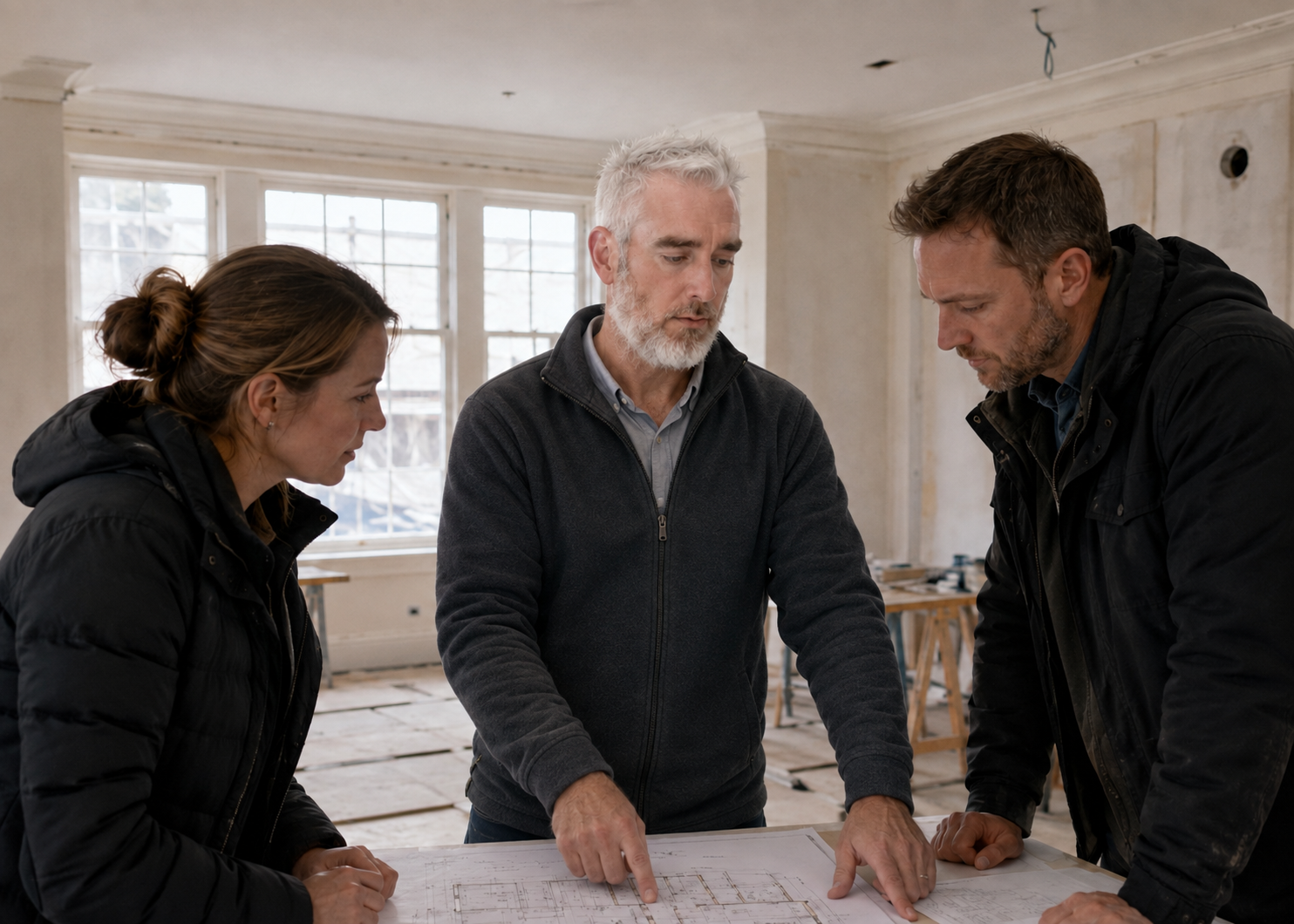
Can a builder price from planning drawings? What to check first
Planning drawings can support an early budget, but the price may rest on unresolved design and scope. Here are the checks to make before asking builders for a firm quote.
Yes, a builder can give you an early budget from planning drawings. But a price based only on those drawings is likely to depend on assumptions. Before you treat it as a firm, comparable quote, find out exactly what has been designed, specified and included.
Planning drawings explain the proposed layout and appearance. They may be enough to test whether a project is broadly affordable. They do not, by themselves, settle every construction detail, material choice or responsibility that determines the final cost. Planning permission and building regulations approval are separate processes, as the Planning Portal explains. A full-plans building control submission calls for detailed construction information; even then, a price needs a clear scope and specification.
What might still be missing?
The gaps depend on the job. Before asking several builders to give you a price, check these areas:
Structure: have the engineer's design, steelwork, bearings, floor and roof changes been resolved?
Materials and finishes: which windows, insulation, roof coverings, doors, sanitaryware, tiles and finishes are actually specified?
Services: where will drainage, heating, ventilation and electrics go, and who makes good afterward?
Existing house: what must be protected, opened up, altered or repaired as part of the work?
Access and sequence: how will scaffolding, deliveries, waste removal and weather protection work, especially if you remain living at home?
Boundaries of the quote: which design fees, approvals, utility changes, kitchen or bathroom items, decoration and floor finishes are included, excluded or client supplied?
For example, a drawing of a loft with dormers and bathrooms can show the rooms clearly while leaving the structural steel, rafter alterations, drainage route and finish choices unresolved. Those are real cost and programme decisions. The point is to list the uncertainty, not to invent a precise material quantity from incomplete information.
Ask for the right kind of price at the right stage
If your information is early, ask for an indicative budget with a stated range, basis, assumptions, exclusions and next design decisions. That is useful for feasibility. It should not be presented as though every trade has been measured and fixed.
For a more reliable comparison, give each builder the same current drawing set, structural information, specification and schedule of works. Ask them to identify qualifications, provisional sums and omitted work in writing. The RICS New Rules of Measurement provide an established framework for cost planning and measurement; the level of detail in an estimate should reflect the information available.
Before you accept a quote
List every drawing and revision issued for pricing.
Ask what each builder has assumed where details are missing.
Put allowances, provisional sums and exclusions side by side.
Check whether site setup, scaffolding, waste, protection and making good are covered.
Resolve the biggest design questions before signing a contract or agreeing a payment schedule.
A low total can mean a leaner build method, different materials or simply a different interpretation of the job. Compare the work and risk behind the figures, as well as the figures themselves. Our guide to comparing builders' quotes takes that next step.
How Build Advocate can help
If you have drawings but are unsure what can sensibly be priced, our Cost & Readiness Assessment reviews the design, scope, budget and delivery risks, with an evidenced estimate suited to the available information. We identify the decisions and specialist details needed before you ask builders for firmer prices. It does not replace an architect's or engineer's design.
Every project differs. Treat the checklist as a starting point and check the actual documents for your job.
Builder asking for more money than quoted? What to check first
A builder has asked for more money than expected. Identify what changed, gather the evidence and understand the next practical step before agreeing extras.
By Build Advocate
If your builder asks for more money, start by establishing what the request is for. Is it a change you requested, an adjustment to an allowance, newly discovered work, or something the builder says was excluded? Ask for a written breakdown and compare it with the agreed scope and payment arrangements.
The request itself does not tell you whether the extra is justified. The reason, evidence and agreement matter.
Separate an extra cost from an earlier payment
A builder might be asking for a higher total price, or simply asking for an agreed payment sooner. Those are different issues.
Write down the amount, the requested payment date and whether the overall project price is changing. If the request concerns materials or a supplier invoice, ask what is being ordered and how that fits the agreed payment schedule.
Identify the reason
You changed the design or specification: Request the instruction, revised work and cost difference.
An allowance is insufficient: Request the original allowance, proposed selection or actual quantity, and adjustment calculation.
Unexpected conditions were found: Request photos or findings, the proposed solution, and relevant scope wording.
The work was excluded: Request the quoted exclusion and an explanation of who was expected to provide it.
Materials or labour became more expensive: Request the calculation and any agreed price-adjustment provision.
The builder needs cash sooner: Request the existing payment terms and the specific commitment the money would fund.
These categories help organise the discussion. They do not, on their own, determine what you are legally obliged to pay.
Gather the documents before the conversation becomes an argument
Keep the accepted quotation, contract, drawing revisions, specification, payment record and messages agreeing changes together. Make a short timeline of the instruction, work and payment request.
For example, “extra electrical work” is too broad to assess. A useful breakdown identifies the additional points, who requested them, whether they were already shown, and the materials and labour being charged.
Check the whole calculation
An alteration may add one item while removing another. Ask whether omitted work has been credited, whether the original allowance has been deducted, and whether the figures include applicable VAT and any agreed additions.
Also ask about time. A late change can affect ordering, sequencing and the finish date, even if the physical installation is small. Agree the proposed cost and programme effect together wherever possible.
Ask for a clear written explanation
You can keep the request straightforward:
“Please send a breakdown of the additional amount, the work it relates to and the relevant quotation or contract item. Please identify any instruction or allowance adjustment, credits for omitted work, and the effect on the programme. I would like to review those together before agreeing the change.”
Keep the discussion focused on the disputed items. A short list showing agreed, unconfirmed and disputed amounts is usually more useful than restarting the entire project argument in every message.
If agreement is difficult
Ask the builder to respond to the specific gaps in the evidence. A construction review can help explain scope, quantities and delivery implications. Questions about contractual entitlement, withholding payment or terminating the appointment may need legal advice based on the actual agreement.
Do not assume a general online article settles those decisions. Keep records and use the appropriate support for the issue. Citizens Advice provides guidance on problems with building work; that linked page is for England, so select your nation for the relevant guidance.
Need help understanding the request?
Build Advocate's Rescue Initial Assessment costs £225 and includes a one-hour review call. We assess the issue and available evidence, explain uncertainties and identify practical next steps. Further intervention or specialist work is separately scoped. This is construction advice, not legal representation.
If you are still choosing a builder, our guide to comparing builders' quotes explains how to identify scope gaps before appointment.
How to compare builders’ quotes when the prices and inclusions differ
Compare builders’ quotes by scope, allowances, exclusions, payments and programme. A worked example explains why the lowest total may not be comparable.
By Build Advocate
To compare builders’ quotes properly, first check that they price the same work. Put the drawings, specifications, inclusions, exclusions and allowances alongside each other before comparing the totals. Then examine how each builder proposes to deliver and fund the job.
A detailed comparison should leave you with fewer unknowns—not simply a preferred price.
Start with the information each builder received
Were all builders sent the same drawing revisions and specification? Did one visit the property while another priced from planning drawings? Has the design changed since the earliest quote?
Record the drawing references and dates behind each proposal. If the information differs, ask for the affected prices to be updated against a common scope. Otherwise you may be comparing different projects.
Put the scope side by side
Use this checklist and ask each builder to clarify the gaps in writing.
Structural work: Which design, steelwork, floor and roof alterations are included?
Access and setup: Are scaffolding, deliveries, skips, protection and welfare included?
Plumbing and electrics: What points, fittings, connections and testing are allowed for?
Finishes: Which plastering, decoration, joinery and floor finishes are included?
Client purchases: Who buys sanitaryware, tiles, kitchen fittings and other selected items?
Completion: What making good, removal of waste and handover information are included?
Tax and other costs: Is VAT included where applicable, and which professional or statutory fees sit outside the quote?
Avoid treating a blank entry as either included or free. Mark it as unconfirmed until the builder explains it.
Separate fixed prices from allowances
An allowance gives part of the project a provisional value. Its usefulness depends on what it covers and how it will be adjusted.
For each allowance, ask what quantity and specification it assumes, whether installation is included, and what happens if the selection or actual work costs more or less. Check whether overhead, profit and VAT will also affect the adjustment.
An allowance that is too low can make a proposal look attractive today while leaving you with a larger bill later. That does not mean every allowance is unreasonable: some work cannot be fully priced until more information is available.
A worked comparison
These figures are invented to demonstrate the method. They are not market rates or a real customer's quotations. Assume the same tax basis throughout.
Builder A
Headline total: £80,000
Scaffold omitted from headline: £5,000
Decoration omitted from headline: £3,000
Adjustment to the same bathroom allowance: £2,000
Comparison total: £90,000
Builder B
Headline total: £87,000
Scaffold: included
Decoration: included
Adjustment to the same bathroom allowance: £0
Comparison total: £87,000
Builder A's headline is £7,000 lower. With those scope differences included, its comparison total is £3,000 higher. In a real assessment, obtain evidence for every adjustment rather than filling the gaps with convenient guesses. Unpriced uncertainty should remain visible.
The adjusted total is still only one part of the decision. It does not establish workmanship, availability or the reliability of either builder.
Check the programme and payment proposal
Ask who will be working on the project, what work can overlap, and which deliveries or decisions control the finish date. A short duration needs a credible delivery method behind it.
Look at when payments become due and what they fund. Early procurement and mobilisation may need money before visible construction progresses, but the scope, timing and evidence should be clear. Later payments should relate to defined work or agreed commitments. A standard percentage alone does not explain whether a payment plan suits your job.
Check the builder as well as the document
Confirm the identity of the business you will contract with, relevant experience, references and the proposed team. Ask about comparable projects, not just attractive photographs. Establish who communicates with you, handles changes and resolves incomplete or defective work.
Before choosing, get one clarified version
Bring accepted clarifications into the quotation, scope and proposed contract documents. Important promises scattered across texts and conversations are harder to track during construction.
You should be able to explain what you are buying, what remains uncertain, who is responsible for each part and how changes will be handled.
Want an independent review before you commit?
Build Advocate’s Homeowner Project Review & Build Support brings plans and buildability assessment, checks on up to three builders, pre-construction arrangements, programme and payment review into one comprehensive written report. The £999 package includes one consultation call and agreed milestone check-ins through completion.